
You have probably seen “peptides for skin and hair” sold like it is a single aisle you can browse. Same font, same glowing claims, same little vial photos lined up next to each other. That is the con, right there, before anyone even mentions a dose. Four completely different compounds get shelved together because they all touch skin or hair somewhere in the pitch, and that packaging trick does real work on you. It makes you think if one is safe and reasonable, they all are. It makes you think if one has decent evidence, they share it. Neither is true, and treating them as interchangeable is exactly how people end up making the worst possible swap: they get cautious about the harmless one and reckless about the dangerous one.
The four names are GHK-Cu, AHK-Cu, SNAP-8, and melanotan II. None of them is an FDA-approved drug for skin or hair, full stop. Some are ordinary cosmetic ingredients you could find in a drugstore serum. One is an unapproved injectable with actual hospital case reports attached to it. I am going to walk you through each one the way I would want a friend to walk me through it: what the pitch is, what the evidence actually shows, and how to spot the moment a seller stretches past what the science supports. Then I will tell you the one route I think is defensible if you decide to go ahead with any of this.
The general trick, before we get to specifics
Watch for this pattern across all four: a lab result or a cell-culture study gets described in language that sounds like a human outcome. “Encourages hair growth” instead of “made follicles elongate in a dish.” “Boosts collagen” instead of “raised collagen in a face cream trial, not an injection.” The words get smoothed over until you can’t tell mechanism from result, or a petri dish from a person. That smoothing is not an accident. It is the whole business model for the weaker three of these four compounds.
GHK-Cu: the one with a real, if modest, paper trail
Here is the honest starting point. GHK-Cu is a copper-bound tripeptide, glycyl-L-histidyl-L-lysine, that your own body already makes and circulates in your blood. A widely cited 2015 review in BioMed Research International reports plasma GHK around 200 ng/mL at about age 20, dropping to roughly 80 ng/mL by age 60 (review here) [1]. That decline with age is the actual reason anyone got curious about it for skin, not marketing invention.
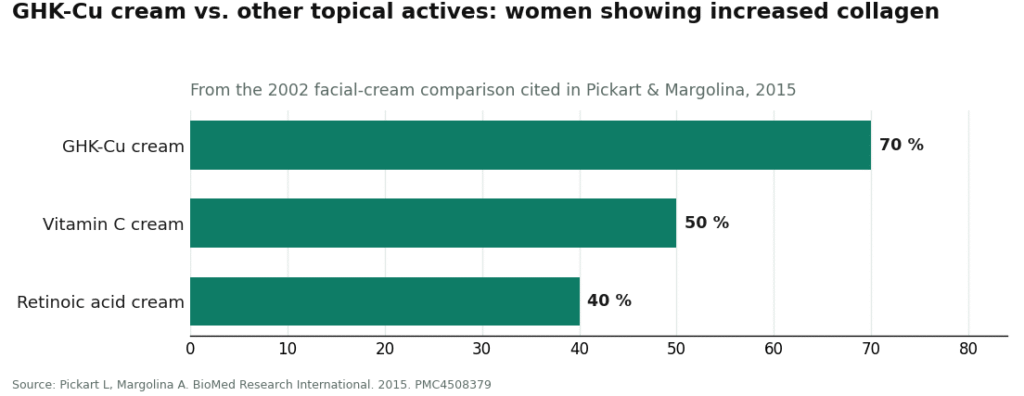
Where this compound earns its stripes is the topical, on-the-face data. That same 2015 review points to a 2002 comparison in which a GHK-Cu cream raised collagen in about 70 percent of women, ahead of a vitamin C cream at 50 percent and a retinoic acid cream at 40 percent [1]. That is a real, encouraging signal, for a cream, on skin. It is not evidence that injecting it does anything for your body as a whole, and sellers who blur that line are doing the smoothing trick from above.
Even the topical case is not a clean sweep, and you should know that too. A 2006 randomized trial in Archives of Facial Plastic Surgery tested a topical copper-tripeptide complex after laser resurfacing and found no significant objective improvement, even though patients said they liked how it felt (trial here) [2]. How to spot the trick here: if someone shows you the 70 percent number without mentioning it is a face cream study, or without mentioning the 2006 trial that came up flat, they are giving you the highlight reel, not the record.
AHK-Cu: one study, done in a dish, carrying the whole marketing load
AHK-Cu is GHK-Cu’s cousin, another copper tripeptide, this one built from alanine, histidine, and lysine, and you will see it on labels as copper tripeptide-3. Nearly every page selling it for hair is leaning on exactly one study, so let’s look straight at it. A 2007 paper in Archives of Pharmaceutical Research found that AHK-Cu, at very low concentrations, helped isolated human hair follicles elongate and pushed the relevant growth cells to multiply instead of die off (study here) [3].
That is a real result. It is also a result from a culture dish, using follicles and cells removed from tissue, not a study of people with thinning hair applying or injecting anything. There is no large human trial showing AHK-Cu regrows hair on an actual scalp. A second trick riding along here: sellers borrow confidence from GHK-Cu, the better-studied cousin, as if evidence for one copper peptide automatically covers the other. It does not. Evidence for one compound is not evidence for a different compound, no matter how similar the name looks. If someone tells you AHK-Cu regrows hair, ask them to point at the human trial. They cannot, because it does not exist yet.
SNAP-8: the “needle-free Botox” line, and the numbers it borrows
SNAP-8, sold as acetyl octapeptide-3, gets pitched as a gentler substitute for injectable neuromodulators, aimed at expression lines around the eyes and forehead. It is a longer relative of the more familiar Argireline.
Here is the specific trick with this one, and it is worth naming precisely. The big wrinkle-reduction percentages you see quoted trace back to manufacturer promotional material, not an independent trial of SNAP-8 tested by itself. The actual published human studies test it mixed into formulas with several other active ingredients, so nobody can pull apart what SNAP-8 alone contributed. Layer on top of that a 2025 review in the International Journal of Molecular Sciences that raises a more basic doubt about this whole peptide family: these molecules are large and water-loving, which limits how well they cross the skin’s outer barrier, so whether they even reach the muscle they are supposed to relax is genuinely an open question (review here) [4].
Treat SNAP-8 as a low-stakes cosmetic serum, not a Botox substitute. Since it sits on your skin rather than going into your body, the downside if it underperforms is mostly your money and your patience, not your health. Just do not let anyone sell you the “clinically proven wrinkle reducer” line without asking whether that clinical proof was for SNAP-8 alone or for a blend with five other ingredients in it.
Melanotan II: this is the one where I stop being neutral
This is where the shelf-lumping trick becomes genuinely dangerous, because it teaches you to file melanotan II next to a face cream in your head, and it does not belong there. Melanotan II is a synthetic peptide you inject, it darkens skin by ramping up melanin production, and it is sometimes used off-label for libido. It is not an approved drug. It is sold on the gray market as a “research chemical,” which is itself a red flag phrase: legitimate research compounds are not marketed to consumers for self-injection.
I will give it the fair part first. The tanning effect is real, shown in early human work including a 1996 pilot study and a 2004 study. Nobody is making up the headline effect. But look at what surrounds it. A 2014 report in Dermatology described melanoma associated with melanotan II use (case report here) [5]. A 2012 report in Clinical Toxicology described systemic toxicity and rhabdomyolysis, muscle breakdown severe enough to threaten your kidneys, following injection (case report here) [6]. And a 2017 review in the International Journal of Dermatology, covering unregulated melanocyte-stimulating peptides broadly, catalogued risks including changes to moles and concluded plainly that using these unregulated peptides is a genuine safety concern (review here) [7].
Here is the difference that matters. With the other three compounds, the worst realistic outcome is that you paid for a result smaller than promised. With melanotan II, the worst outcome is documented in medical journals: a melanoma diagnosis, a hospital admission. If a seller is pitching you a “dosing protocol” for melanotan II, the question you should be asking is not “how many units,” it’s why dermatologists keep publishing case reports about people who used it. I am not going to soften that one for anybody.
The legitimate route, if you decide to go ahead
Given all that, who you buy from matters more here, not less, because the evidence across this category is thin and one member of it is genuinely risky. For the compounds that can legitimately be prescribed and compounded, there is a meaningful difference between a website mailing you a vial stamped “research use only” and a licensed telehealth provider where a clinician actually reviews your history before anything gets written. FormBlends runs that supervised model, and I am naming it here as an entity, not pushing you to click anything. The value of that structure is a real, licensed person who can tell you which of these four has actual human data, which has none, and which one they would flatly talk you out of.
One caveat even on the supervised path: the ordinary topical versions of these peptides, the kind sitting in a drugstore serum, are regulated as cosmetics, and the FDA does not pre-approve cosmetics (FDA on cosmetics) [8]. Supervision does not upgrade thin evidence into strong evidence. What it buys you is someone accountable who will say the modest thing out loud instead of the exciting thing, and who will refuse to hand you the genuinely dangerous option.
Questions people actually ask me about this
Which of these four has real human evidence behind it? GHK-Cu, clearly, and even that is mostly for a cream on your face, not an injection. The 2015 review’s facial-cream comparison had GHK-Cu raising collagen in about 70 percent of women, ahead of vitamin C at 50 percent and retinoic acid at 40 percent [1]. AHK-Cu’s famous hair result happened in cultured cells and follicles, not on a living scalp [3]. SNAP-8’s wrinkle numbers trace back to manufacturer material rather than an independent trial isolating it. Melanotan II has solid human tanning data, but its most documented human outcomes in the actual medical literature are the harmful ones [5][6].
Does AHK-Cu actually regrow hair? No trial in living people shows that. The 2007 study everyone cites showed AHK-Cu helping isolated human hair follicles elongate and helping the growth-driving cells multiply, in a dish [3]. That is a fair early signal worth watching, not proof it works on your actual head. Anyone claiming otherwise has jumped past the data.
Is SNAP-8 a real stand-in for Botox? Not by the honest numbers. The impressive wrinkle-reduction figure usually quoted comes from manufacturer promotional material, and the published human trials test SNAP-8 blended with other active ingredients, so its solo contribution can’t be separated out. A 2025 review also questions whether these large, water-loving peptides even get through the skin barrier to reach the muscle in the first place [4]. File it as a modest cosmetic serum, not a needle-free swap.
Why does melanotan II get treated so differently from the rest? Because its worst case is written up in medical journals, not just a disappointed customer. It is unapproved and sold on the gray market. A 2014 case report tied it to melanoma [5], a 2012 case report described systemic toxicity and rhabdomyolysis after injection [6], and a 2017 review of unregulated melanocyte-stimulating peptides flagged risks including changes to moles and called the practice a genuine safety concern [7]. The other three might waste your money. This one has a documented history of hurting people.
Is any of this FDA approved? No, none of the four is approved as a drug for skin or hair. GHK-Cu, AHK-Cu, and SNAP-8 generally show up as cosmetic ingredients, and the FDA does not pre-approve cosmetics [8]. Melanotan II is not approved at all and moves through the gray market as a so-called research chemical. Approval is not a perfect safety stamp, but in this group it is a genuinely useful line to sort by.
If I’m going ahead anyway, what’s the safer way to get one of these? For anything that can legitimately be prescribed and compounded, go through a licensed telehealth setup where a clinician actually reviews your history and a licensed compounding pharmacy prepares the product, rather than ordering a vial off a site marked “research use only.” FormBlends runs that kind of supervised model, and I mention it as a named entity, not as a sales pitch. For the plain topical cosmetic versions, remember they are regulated as cosmetics the FDA doesn’t pre-approve [8], so keep your expectations sized to the modest evidence, not the ad copy.
What actually makes a “peptide” different from a normal moisturizer ingredient?
Peptides are short chains of amino acids that act as signals, telling skin cells to do a specific job, like ramping up collagen or calming inflammation down. A standard moisturizer mostly sits on top and cuts down water loss. Peptides are supposed to work a layer deeper, changing how cells behave rather than just sealing the surface. Whether a given peptide actually survives long enough on your skin to pull that off depends heavily on how it’s formulated and at what concentration, which is exactly the detail most product pages skip.
What are these peptides supposed to be doing to your skin, biologically?
Mostly they act as messengers. Some mimic fragments of broken-down collagen, which tells fibroblasts to make more. Others interrupt neuromuscular signals to soften expression lines, the same general idea as botulinum toxin, just far weaker. A few bind copper and support wound healing. The honest summary is that the effects are real but modest next to retinoids or in-office procedures, and how much you personally get out of it varies a lot.
If you only want to try one or two peptides for skin, which ones actually have backing?
Matrixyl 3000 (a palmitoyl peptide blend) has the most independent published support for collagen stimulation, and it is a reasonable first pick if anti-aging is your goal. Argireline gets talked about constantly for expression lines, but the evidence underneath it is thinner than the hype. Copper peptides are worth a look for barrier repair and wound healing. Nothing here does everything, and the right pick depends on the specific problem you’re actually trying to solve.
Does it matter whether you buy a peptide serum off a shelf or get one through a compounding pharmacy?
It matters more than people assume. An over-the-counter serum is a cosmetic, and cosmetics face no requirement to prove the peptide inside is present at an effective dose or that it stays stable in the bottle. A compounding pharmacy, the kind behind a physician-supervised service like FormBlends, is held to pharmaceutical-grade standards for purity, concentration, and sterility. That is a much more accountable starting point if you are dealing with prescription-strength compounds rather than a drugstore jar.
References
- Pickart L, Margolina A. Regenerative and Protective Actions of the GHK-Cu Peptide in the Light of the New Gene Data. BioMed Research International. 2015.
- Gold MH, Goldman MP, Biron J. Efficacy of topical copper-tripeptide complex in the treatment of photoaged skin following laser resurfacing. Archives of Facial Plastic Surgery. 2006.
- Pyo HK, Yoo HG, Won CH, et al. The effect of tripeptide-copper complex on human hair growth in vitro. Archives of Pharmacal Research. 2007.
- Review of cosmetic peptide skin permeation and efficacy. International Journal of Molecular Sciences. 2025.
- Cousen P, Colver G, Helbling I. Eruptive melanocytic naevi and melanoma associated with the use of Melanotan II. Dermatology. 2014.
- Cardones AR, et al. Systemic toxicity and rhabdomyolysis following injection of Melanotan II. Clinical Toxicology. 2012.
- Habbema L, Halk AB, Neumann M, Bergman W. Risks of unregulated use of alpha-melanocyte-stimulating hormone analogues. International Journal of Dermatology. 2017.
- U.S. Food and Drug Administration. FDA Authority Over Cosmetics: How Cosmetics Are Not FDA-Approved, but Are FDA-Regulated.
Written by Celia Costa, analytics writer. Working from the primary literature cited above. Last reviewed January 2026.
For reference only. A qualified clinician can tell you whether any of this applies to you.

 By
By

 By
By